





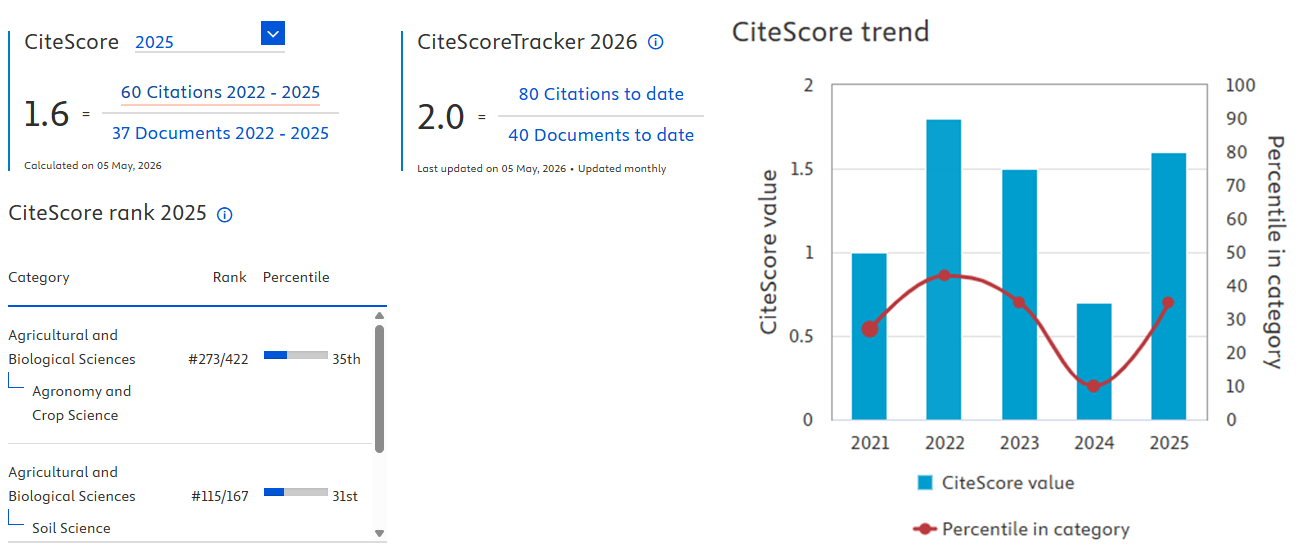
Organic Farming (OF), published by Acadlore, has maintained consistent third‑quartile (Q3) positioning across three agricultural and biological sciences categories in the CiteScore 2025 release, reflecting the journal’s stable academic contribution to applied organic agriculture research. With a CiteScore of 1.6 (60 citations over 37 citable documents, 2022–2025), the journal shows steady upward momentum.
Detailed category rankings (Q3 in all three categories):
Agricultural and Biological Sciences (Agronomy and Crop Science): 273rd out of 422 journals (35th percentile)
Agricultural and Biological Sciences (Soil Science): 115th out of 167 journals (31st percentile)
Agricultural and Biological Sciences (Food Science): 290th out of 420 journals (31st percentile)
CiteScore is a transparent and comprehensive metric calculated by Elsevier from data in Scopus, the world’s largest abstract and citation database of peer‑reviewed literature. This metric has been widely adopted by researchers and institutions worldwide as a robust indicator of journal performance and scholarly influence.
OF is an international peer‑reviewed open‑access journal dedicated to advancing research on organic agriculture and sustainable food systems, fostering interdisciplinary scholarship that integrates agronomy, ecology, food science, environmental management, and socio‑economic analysis. The journal places particular emphasis on soil and crop health, ecological pest management, climate‑resilient farming, biodiversity enhancement, certification systems, and market development for organic products. By combining scientific rigor with real‑world agricultural relevance, OF provides a unique platform for applied research that supports evidence‑based organic practices and sustainable rural development. The journal brings together local organic farming experiences from around the world, balancing indigenous diversity and transferable knowledge to generate academic outcomes that contribute to the global goal of sustainable agriculture.
In recent years, OF has strengthened its editorial standards and peer‑review process, ensuring methodological transparency, analytical rigor, and practical applicability. A consistent publication schedule and a growing international author base have further contributed to the journal’s stable performance across multiple agricultural disciplines. The current Q3 ranking represents a solid foundation for the journal’s continued development. Ongoing efforts will focus on advancing high‑quality, practice‑oriented research in organic production systems, regenerative agriculture, and technology‑enhanced organic farming practices.
The editors extend sincere gratitude to all authors, reviewers, and editorial board members who have supported the journal’s development.
Power Engineering and Engineering Thermophysics Accepted for Indexing in Scopus
Aug 18, 2026 PEET
Mechatronics and Intelligent Transportation Systems Accepted for Indexing in Scopus
Aug 18, 2026 MITS