





The Journal of Engineering Management and Systems Engineering (JEMSE), published by Acadlore, has achieved a second‑quartile (Q2) ranking in all four engineering categories in the CiteScore 2025 release, marking an outstanding result in its first year of Scopus indexing.
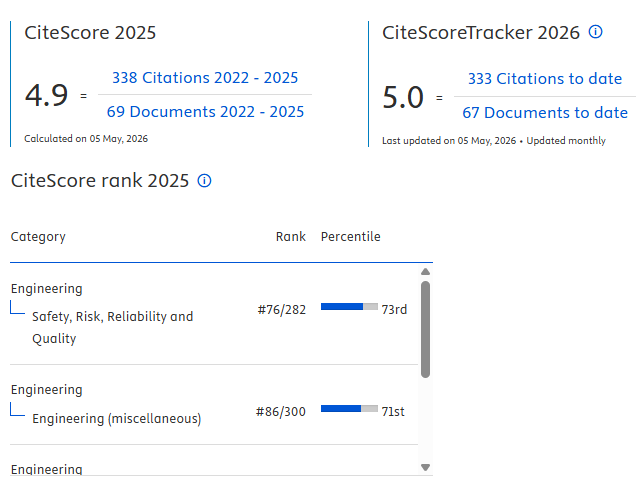
With a CiteScore of 4.9 (338 citations over 69 citable documents, 2022–2025), the journal achieves Q2 rankings in four engineering categories as follows:
Engineering (Safety, Risk, Reliability and Quality): 76th/282 (73rd percentile)
Engineering (miscellaneous): 86th/300 (71st percentile)
Engineering (Industrial and Manufacturing Engineering): 135th/425 (68th percentile)
Engineering (Control and Systems Engineering): 130th/390 (66th percentile)
JEMSE has consistently focused on publishing research that bridges engineering systems methodologies with advanced management practices. Particular emphasis is placed on structured decision-making, system optimisation, and application-driven research addressing complex engineering challenges. Aligning with research trends, the journal concentrates on cutting-edge, innovative, and highly practical niche academic areas, offers a unique platform for both methodological innovation and actionable industrial insights.
Also in recent years, JEMSE has strengthened its editorial standards and peer-review process, ensuring clarity of contribution, methodological rigour, and practical relevance. A consistent publication schedule and an increasingly international authorship have further contributed to the journal’s growing impact.
The current Q2 ranking represents an important step in the journal’s development. Continued efforts will focus on advancing high-quality research that integrates analytical modelling, systems thinking, and real-world engineering applications.
The editors extend sincere gratitude to all authors, reviewers, and editorial board members who have supported the journal’s development.
Mechatronics and Intelligent Transportation Systems Accepted for Indexing in Scopus
Aug 18, 2026 MITS
Power Engineering and Engineering Thermophysics Accepted for Indexing in Scopus
Aug 18, 2026 PEET