
 Open Access
Future Mitigation of the Residential Building Heat Load Using the Pergolas and Deciduous Climber

 View Full Article|
 Download PDF
Abstract:
This paper critically examines the possibilities of combining pergolas and V. Coignetiae as energy-efficient, bioclimatic, green architecture and passive solar systems in the single-family building located in a moderate continental climate zone, i.e. Kragujevac (Serbia). More precisely, the impact of facade wall (without transparent elements) orientation with and without the mentioned measures (elements) on the electricity consumption for space cooling from 1 April to 31 October is investigated. The initial building model was developed using Google SketchUp software and following the Serbian Rulebook on Energy Efficiency for New Buildings. The thermo-technical systems and occupancy were simulated with EnergyPlus software. Based on the simulations conducted and the results obtained, the following main conclusions can be drawn: (1) Moderate continental climate is suitable for implementing the proposed concept; (2) Electricity consumption for space cooling, in the single-family building without energy-efficient, bioclimatic, green architecture and passive solar systems, is the highest when the facade wall (without transparent elements) is oriented to the North (827.25 kWh); and (3) Pergolas and adopted deciduous climber, placed in front of the facade wall (without transparent elements), reduce the electricity consumption for space cooling the most in the case of an Eastern orientation (363.7 kWh).
1. Introduction
The term bioclimatic design is closely related to green architecture [1], energy efficiency [2] and sustainable development [3] terms. All these terms share a common basis, because they represent concepts, strategies, methods, etc., introduced in the period when the professional and scientific public entered the struggle against climate change. This struggle is very intense today. A special place of struggle is the moderately continental climate region [4], where the clear boundaries between the 4 seasons are gradually eroding, and thus, the optimal conditions for life.
Bioclimatic design can be defined as an architectural direction that deals with the implementation of natural elements in buildings of different purposes, with the aim of better connecting people with the environment. These effects, which have a positive effect on the mental and physical health of people, cannot be achieved without the use of natural materials [5] (wood, stone, etc.) and natural location parameters [6] (sun, wind, water resources, vegetation, soil characteristics and terrain configuration). These effects cannot be achieved without the use of renewable energy sources [7], primarily solar energy [8], through passive solar systems [9].
Passive solar systems [10], unlike active solar systems [11], are not primarily intended for direct and independent use of the solar energy, but are elements created exclusively from building materials [12], and which by their design (mechanical, optical, geometric and thermal characteristics) enable the use of solar energy, without the use of additional mechanical elements and devices. Passive solar systems are used for indirect space heating or cooling in buildings. This reduces the final and primary energy consumption from active heating and cooling systems, so temperature comfort is easily achieved and maintained. The group of heating passive solar systems includes the following elements: Trombe walls [13], selective coated facade walls [14], greenhouses [15], thermal storage walls [16], etc. On the other hand, the group of cooling passive solar systems includes elements such as: overhangs [17], pergolas [18], blinds [19], vegetation [20], etc.
Although attention has been paid to passive solar systems, there are still underexplored and insufficiently explored areas of their application. In this paper, the research subject is the residential building located in Kragujevac, Central Serbia. Given that the modern designed building is located in a region with a moderate continental climate affected by climate change (the number of heat waves has been increasing in recent years according to data from the study [21]), this paper uses recent weather files (from 2009 to 2023) and numerical simulations (in Google SketchUp and EnergyPlus software) to investigate the possibilities of using bioclimatic design (based on pergolas and concrete deciduous climber, i.e. V. Coignetiae) in energy purposes during the seven-month extended summer season period (from 1 April to 31 October), taking into account the orientation of the building.
The authors, through this paper, aim to support the professional and scientific public in the fight against climate change by promoting relatively simple solutions to reduce final energy consumption, specifically, space cooling.
2. Methodology
This Section deals with the following topics: building physics and thermo-technical systems, i.e. air-condition units for space cooling (Sub-Section 2.1), specific pergola design and use of V. Coignetiae as a deciduous climber to reduce cooling energy consumption (Sub-Section 2.2), meteorological files for a location in a moderate continental climate zone (Sub-Section 2.3). Finally, the flow of the numerical investigation is described in Sub-Section 2.4.
In this numerical study, the research subject is the residential building model (the total net area of the building floor Afl,tot = 114.45 m2, the total net area of the building floor Vtot = 297.57 m3, the form factor of the building ftot = 1.02 m-1 and the window-wall ratio of the building WWtot = 8.74%), intended for the permanent residence of a family of four. Characteristic isometric and horizontal cross-section views are shown in Figure 1.


From Figure 1, it is evident that the building features a modern design, with the second floor recessed and the roof being flat, i.e., without a slope. Additionally, the building is designed in accordance with the principles outlined in the Serbian Rulebook on Energy Efficiency of New Buildings (Table 1).
Building Element | Umax [W· m-2· K-1] | Uad [W· m-2· K-1] |
Floor | 0.3 | 0.3 |
Wall | 0.3 | 0.3 |
Flat roof | 0.3 | 0.3 |
Window | 1.6 | 1.6 |
Door | 1.5 | 1.5 |
According to the recommendations from the same document [22], the number of air changes n [h-1] for all rooms within the building shown in Figure 1 are: n = 0.5 h-1 (hall 1, study room, staircase, living room, hall 2, bedroom 1, bedroom 2) and n = 1.5 h-1 (toilet, kitchen, bathroom).
All rooms in the building are equipped with appropriate cooling units, which prevent overheating above 26°C during the analyzed period. Classic individual air-conditioned units (the heat power of the air-conditioned units Qcool = 3500 W and the coefficient of performance of the individual air-conditioned units COP = 2.61 [22]) form the space cooling system. Air-conditioned units operate in on/off mode.
External pergolas in front of the non-transparent facade wall (Figure 2a) were created in Google SketchUp software using the New EnergyPlus Shading Group tool from the Legacy OpenStudio palette. The same procedure was used in the case of creating deciduous climber, i.e. V. Coignetiae (Figure 2b).
Wooden boards (Figure 2a), with a cross-section of 40 × 40 mm and a total length of 79 m, form a vertical frame, i.e. external pergolas, with dimensions of 8 × 5.2 m at a distance of 1 m from the non-transparent facade wall. The frame is attached to the non-transparent facade wall on its edges with supports (13 of them in total). The supports ensure that the selected deciduous climber grows unhindered, without mechanically endangering the non-transparent facade wall in front of which it is placed.
The deciduous climber (Figure 2b) is approximated by rectangles (1.94 × 1.25 m) that fill the space between the wooden boards. Its main purpose is to reduce the yield of total solar irradiance Itot [W·m-2], primarily direct solar irradiance Idir [W·m-2], on the external side of the non-transparent facade wall, which is described as the so-called bioclimatic solar shading BSC [-] parameter. Its values range between 0 and 1. The closer the BSC value is to 1, the weaker the effectiveness of stopping solar radiation. On the other side, if the BSC value approaches 0, the shading is stronger and the final energy consumption for space cooling Efin,cool [kWh] is lower. An additional benefit of using a deciduous climber is the mechanical protection it provides to the thermal envelope, in this case, the non-transparent facade wall, from mechanical damage that may occur, for example, due to adverse weather conditions.
In this paper, V. Coignetiae was chosen because of its favorable BSC values during the extended summer season. Average monthly values of the BSC for this deciduous climber for the period from April to October are shown in the following diagram (Figure 3).
Based on values shown in Figure 3, solar shading values tend to a minimum from June to September (BSC < 0.2). Specifically, the lowest value is reached in July, when BSC = 0.12. BSC > 0.3 are achieved in April (BSC = 0.57) and May (BSC = 0.39)—leafing period, as well as in October (BSC = 0.5)—leaf fall period.
Kragujevac is the fourth-largest city in Serbia. It is the seat of the Šumadija district within the region of Western Serbia. It is located about 100 km South of the capital, Belgrade. The geographic coordinates of the city are: $\Phi$ = 44.02°N, $\lambda$ = 20.92°E, el = 185 m.
The climate zone is moderate continental, so it is suitable for the implementation of bioclimatic strategies and measures (for example: external pergolas and deciduous climber, Figure 2) in buildings, to achieve energy efficiency in the residential sector. The average monthly values of the main meteorological data for the city of Kragujevac during the seven months are shown in Table 2.
Month | tair [°C] | φair [%] | cwd [m · s-1] | Dwd [°] | Hdir [W · m-2] | Hdiff [W · m-2] |
IV | 13.22 | 65.75 | 1.28 | 202.62 | 228.28 | 68.91 |
V | 16.64 | 72.95 | 1.73 | 211.34 | 213.88 | 84.29 |
VI | 20.81 | 66.44 | 2.18 | 232.16 | 241.83 | 85.07 |
VII | 22.83 | 66.80 | 1.68 | 215.98 | 266.77 | 77.38 |
VIII | 23.19 | 59.35 | 1.73 | 205.57 | 257.56 | 65.90 |
IX | 18.46 | 64.80 | 1.91 | 204.22 | 196.95 | 59.22 |
X | 13.39 | 78.28 | 1.96 | 202.43 | 133.99 | 47.14 |
The focus of this paper is the non-transparent facade wall, that is, the facade wall without external windows and doors, which is not given enough attention in the literature. This building element is common to the living room (first floor), bedroom 1 (second floor) and bedroom 2 (second floor), and as such is interesting for the implementation of specific bioclimatic energy-efficient strategies and measures. Bioclimatic design largely relies on the passive use of renewable energy sources, primarily solar energy, in order to reduce the final energy consumption for space heating and cooling in residential buildings.
The following table (Table 3) shows all analyzed cases of monitoring energy flows (final energy consumption for space cooling during the extended summer season from 1 April to 31 October) in a specific residential building (Figure 1) in accordance with the orientation of the non-transparent facade (first variable) and the equipment with bioclimatic systems (second variable).
Based on Table 3, it can be concluded that a total of 8 simulation scenarios were realized, because the non-transparent facade wall (with and without bioclimatic elements) of the residential building is oriented towards different sides of the world: North, East, South, West.
Orientation | North | East | South | West |
Without bioclimatic elements (measures) | 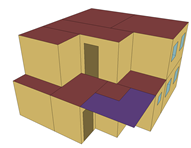 | 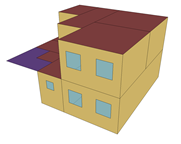 | 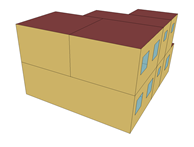 | 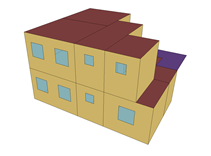 |
With bioclimatic elements (measures) | 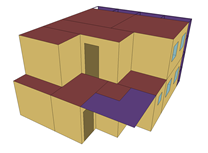 | 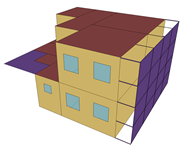 | 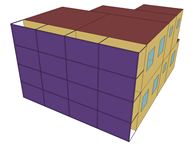 | 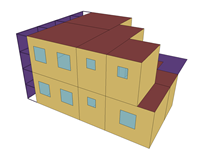 |
3. Results and Discussion
The following diagram (Figure 4) shows the total (seasonal) final energy consumption for space cooling Efin,cool [kWh] depending on the analyzed case, taking into account the parameters defined in Section 2.4 (Table 3): the orientation of the non-transparent facade wall (North, East, South, West) and the existence of a bioclimatic elements (pergolas and V. Coignetiae) in front of that non-transparent facade wall (yes or no).
If the proposed bioclimatic strategy is not applied in the residential building (Table 3 and Figure 4), the consumption of Efin,cool is the highest when the non-transparent facade wall is oriented towards the North (827.25 kWh), and the lowest when the same building element is oriented towards the East (451.57 kWh). The cooling energy consumption is slightly higher in the case of orientation towards the West (487.6 kWh)—compared to the Eastern orientation, while the latter in the case of the South orientation is slightly lower than in the case of the Northern orientation (794.63 kWh).
If the residential building was additionally equipped with external pergolas and deciduous climber (Table 3, Figure 2, and Figure 3), cooling energy consumption would be reduced in the following way (Figure 4): 6.37% (for North orientation), 19.460% (for East orientation), 10.03% (for South orientation) and 20.24% (for West orientation).
The following diagrams (Figure 5) show the monthly consumption of Efin,cool depending on the analyzed scenario (Table 3): North orientation (Figure 5a), East orientation (Figure 5b), South orientation (Figure 5c), West orientation (Figure 5d).
In the case of the orientation of the non-transparent facade wall towards North (Figure 5a), the cooling needs (without I with bioclimatic design) are the highest during the following months: July (273.87 kWh and 258.49 kWh), August (252.32 kWh and 241.59 kWh), June (192.26 kWh and 177.71 kWh). During this time period, the intensities of Hdir and Idir are the highest (Table 2). The lower values achieved when using bioclimatic design are a consequence of the low BSC indicator values (approaching 0). Smaller needs for cooling occur during September (81.57 kWh and 76.3 kWh), which is in accordance with meteorological conditions (Table 2). Meteorological conditions are the reason why Efin,cool = 0 kWh during April and October.
A similar distribution of final energy consumption for space cooling is also in the case of South orientation ( Figure 5c). The consumption is highest in July (265.87 kWh and 247.64 kWh), then in August (243.33 kWh and 222.63 kWh), while in third place is June (185.47 kWh and 169.45 kWh). April and October are still months when there is no need to hire air-condition units, whether bioclimatic and passive solar measures are used or not.
When the non-transparent facade wall is oriented to the East, the entrance door is oriented to the South. The area of all transparent elements on the Southern facade (together with the entrance door) is 6.82 m2, and on the Northern facade it is 6.08 m2, while the entrance door and toilet window are in the shadow of the horizontal overhang (Figure 1). In this case, Efin,cool (Figure 5b) is significantly higher during August (157.99 kWh) compared to July (155.35 kWh) when the partial shading elements are not used. This difference is somewhat larger in the case of using elements for partial shading, if it is lower in comparison with the previously mentioned values: 134.4 kWh (August), 127.88 kWh (July). Based on Figure 5b, it can also be concluded that the cooling season can be additionally shortened by another month, in this case for May.
Just as the energy consumption is similar in the case of the North (Figure 5a) and South (Figure 5c) orientation, so the energy consumption in the case of the West (Figure 5d) orientation is similar (but somewhat less favorable) to the consumption in the case of the East (Figure 5b) orientation: June (80.83 kWh and 57.28 kWh), July (159.21 kWh and 128.71 kWh), August (169.98 kWh and 144.04 kWh), September (65.91 kWh and 51.88 kWh). During October, this consumption amounts to 11.51 kWh and 6.97 kWh (Figure 5d), which can be ignored, as well as in the case of East orientation of the non-transparent facade wall (6.69 kWh and 3.99 kWh, Figure 5b).
At the end, the diagram from Figure 6 shows the percentage savings in final energy consumption for space cooling in the residential building with bioclimatic elements compared to the residential building without bioclimatic elements, of course depending on its orientation. From Figure 6, it can be clearly seen that, in percentage terms, the savings are lower in the height of the cooling season, but at the same time, in absolute numerical values, the savings are the highest precisely in that time period (Figure 5). The highest percentage savings by month (Figure 6) are achieved in the case of Western (May, June, July, August) and Eastern orientation (September). An exception can be considered October, which is inclined to the South orientation.
4. Conclusions
This paper numerically investigated the impact of bioclimatic design on the space cooling in the residential building located in Kragujevac (Serbia). A geometric model of the residential building was created in Google SketchUp software following the Serbian Rulebook for Energy Efficiency in Buildings. All thermo-technical systems are simulated, also following the mentioned Rulebook, in EnergyPlus software. Energy benefits from the use of bioclimatic design (based on pergolas and and V. Coignetiae—as an adopted type of deciduous climber) during the expanded summer season (from 1 April to 30 October) are investigated depending on the orientation of the non-transparent facade wall of the residential building in a moderate continental climate region, i.e. a region that is particularly affected by climate change.
Simulation results show that the final energy consumption for space cooling in the residential building is between 363.7 kWh and 774.59 kWh. In accordance with the geometry of the building, the room layouts, the window-wall ratio, the position of the horizontal intersection, as well as the occupancy schedules of the people and electric equipment, cooling energy consumption is the lowest if it is non-transparent oriented due to the East, while it is the highest in the case of the North orientation. This means that with a smart approach, even in the design phase, taking into account location parameters, the consumption of final energy for space cooling can be significantly reduced.
Residential and non-residential building sectors are highly sensitive links in the chain of energy transformations and balances. Since bioclimatic design aligns with basic natural principles by connecting humans with the environment, future research will focus on further developing the proposed engineering and architectural solutions, as well as exploring similar approaches, to move the sector closer to sustainable development.
Conceptualization, A.N. and R.K.; methodology, A.N. and R.K.; software, A.N.; validation, A.N. and R.K.; formal analysis, A.N. and R.K.; investigation, A.N. and R.K.; resources, A.N. and R.K.; data curation, A.N. and R.K.; writing—original draft preparation, A.N. and R.K.; writing—review and editing, A.N. and R.K.; visualization, A.N. and R.K.; supervision, A.N. and R.K.; project administration, A.N. and R.K. All authors have read and agreed to the published version of the manuscript.
The data used to support the research findings are available from the corresponding author upon request.
The authors declare no conflict of interest.
A | Area, m2 |
BSC | Bioclimatic solar shading |
c | Speed, m · s-1 |
COP | Coefficient of performance |
D | Direction, ° |
E | Energy consumption, kWh |
el | Elevation, m |
f | Form factor |
H | Solar irradiance on the horizontal surface, W · m-2 |
I | Solar irradiance on an arbitrary surface, W · m-2 |
n | Air change, h-1 |
P | Percentage savings, % |
Q | Heat power, W |
t | Temperature, °C |
U | Heat transfer coefficient, W · m-2 · K-1 |
V | Volume, m3 |
WW | Window-wall ratio, % |
Greek symbols | |
λ | Longitude, ° |
Φ | Latitude, ° |
φ | Relative humidity, % |
Subscripts | |
ad | Adopted value |
air | Ambient air |
cool | Cooling |
dir | Direct |
fin | Final |
fl | Floor |
max | Maximum |
tot | Total |
wd | Wind |





 Views: 943
 Crossref: 0