
 Open Access
Identification of Potential Renewable Energy to Support a Community-Based Ice Crystal Micro-Enterprise in Kulon Progo, Indonesia

 View Full Article|
 Download PDF
Abstract:
Indonesia is an archipelagic country with 17,001 islands spread across 34 provinces, in remote, outermost, and farthest islands that are very possible to meet the needs of New and Renewable Energy-based energy. Hydroelectric power plants depend on environmental sustainability conditions and water catchment areas so that the flow of water will continue to be maintained to turn turbines to produce electricity. In rural areas that are not reached by the National Power Plant, you can build micro-scale hydroelectric power plants, and if constrained by very minimal costs, you can build pico-hydro scale power plants. This research method utilizes rooftop area identification using Google Earth (GE) and Unmanned Aerial Vehicle (UAV). The results of this study found the potential of pico-micro-hydro power of 18 kW and solar power plants (Pembangkit Listrik Tenaga Surya, PLTS) Rooftop offgrid 596.83 kWh. This research shows that new renewable energy can sup Dimension Stationport the development of micro-enterprises based on green energy for community welfare.
1. Introduction
Indonesia’s commitment to net zero emissions by 2060 is a joint effort to reduce global warming and reduce the risk of the effects of rising sea levels which have an impact on the sinking of small islands and reduced land area, shifts in seasons, and the impact of spreading disease and virus outbreaks. The cause of global warming is carbon pollution from fossil energy which continues to increase in the atmosphere. The impact of economic activity, population growth, energy consumption, and economic development on CO$_2$ emissions is the main problem of climate change [1]. In the National Energy Council (DEN) in 2019, Indonesia scored 6.57 on the Energy Security Index, placing Indonesia in the ‘resilient’ category. The issue of soaring coal prices in the global market will lead to a shortage of domestic energy supplies in early 2022 and should be considered in the latest assessment [2]. Indonesia-Türkiye has agreed to accelerate the energy transition which is building cooperation in the procurement of electric buses with the B-to-B scheme and Comprehensive Economic Partnership Agreement [3]. Indonesia has a Net Zero Emission 2060 program that must be realized, in 2050 the fulfillment of national energy from new renewable energy is 87%, and in 2060 the fulfillment of national energy is 100% from new renewable energy [4].
An important concern is that Indonesia consists of thousands of islands from Sabang to Merauke. Based on more than 17,000 data, with an archipelago shape, new renewable energy has the potential to be developed. So we need appropriate technology that is easily used by the community to produce environmentally friendly electrical energy and can be easily found and applied in the community with a small discharge. The potential of Pico-hydro power (PHP) as an alternative source of clean energy that is efficient, reliable, and cost-effective [5]. The community will find it easier to build a PHP plant according to their financial capabilities, efficiency, economics, water potential, and potential alternative fluid engines in their environment. Regulations for the classification of micro-hydro in Indonesia $<$1 MW, pico hydropower plants in India $<$0.1 MW, and in Malaysia $<$0.005 MW [6]. Pico-hydro classification in Egypt and Italy $<$0.005 MW [7].
The potential for solar power plants (Pembangkit Listrik Tenaga Surya, PLTS) in Indonesia is enormous and offers significant opportunities to improve community well-being. Therefore, this study aims to integrate renewable energy sources, particularly pico-micro-hydro power and solar photovoltaic (PV) systems, to support the growth of micro-enterprises. This combined approach is expected to meet local energy demands in an environmentally sustainable manner while reducing dependence on fossil fuels.
2. Materials and Methods
This research was carried out around the irrigation channel in Yogyakarta, Indonesia. The existing renewable energy system in the study area is supported by a micro-hydro power plant with an installed capacity of 18 kW, as reported in previous studies [7]. Further development of renewable energy is continuously being explored, including the integration of pico-hydro systems and PV technology to enhance energy availability and system flexibility, as illustrated in Figure 1. The macro–meso–micro spatial approach is applied as a systematic framework for identifying and evaluating pico-micro-hydro power potential within the renewable energy concept, as illustrated in Figure 2.


The first stage consisted of macro-spatial screening and micro–meso spatial verification to identify potential pico–micro hydropower locations. The second stage involved experimental validation of the Pico-hydro Portable Turbine (PPT) through controlled laboratory testing. The third stage comprised field validation of the PPT at selected sites identified during the previous stages. Google Earth (GE) was employed as a preliminary tool for identifying potential micro-hydro and pico-hydro locations by screening elevation differences and geomorphological indications of water drops. Subsequently, Unmanned Aerial Vehicle (UAV) surveys were conducted to verify selected potential sites and to estimate head ($\Delta H$) with higher spatial resolution. Final and precise head ($\Delta H$) measurements were obtained using a Total Station (TS), which served as the reference measurement for detailed engineering design and power potential calculations.
Previous studies indicate that GE elevation data exhibit relatively consistent vertical accuracy; however, they are not sufficiently accurate for precision engineering applications and are therefore more suitable for preliminary screening and site selection [8]. In this study, the typical vertical accuracy ranges were approximately 5–10 m for GE, ±1 m for UAV-derived data, and up to ±0.01 m for TS measurements. Accordingly, to enhance measurement reliability and scientific replicability, elevation estimates derived from GE were systematically verified using UAV surveys and further refined through high-precision TS measurements.
However, beyond pico-hydropower development, this study further examines the potential integration of PV systems as an additional renewable energy source. The rooftop area was determined using GE, which may differ slightly from actual field conditions. However, by considering only 10% of the rooftop area for PV potential, the estimated values are considered reasonably reliable. In particular, the installation of rooftop PV systems on 53 households connected to the existing micro-hydropower network is proposed. This approach aims not only to support household electricity demand but also to enable productive energy use. The integration of PV systems provides an opportunity to allocate a portion of the generated energy to micro-enterprise activities, specifically ice crystal production. Given the relatively low power requirement of approximately 250 W per unit, the system allows the simultaneous operation of multiple units while maintaining the stability of household electricity supply. This combined energy approach strengthens the role of community-based renewable energy systems in supporting local economic development.
Analysis of the potential of solar power generation as follows : P (kWh) = A × radiation × coefficient.
where,
P (kWh) = output (kWh), A = roof area (m2), radiation = Yogyakarta (kWh/m2) (The average solar radiation in Yogyakarta is approximately 4.8 kWh/m²/day), coefficient = 15%.
3. Results and Discussions
The classification of power plants in several countries around the world, including Indonesia, is based on the generated power for the Pico-hydro category with a generated power of $<$0.005 MW or $<$5 KW. This classification shows that the potential in Indonesia is very large and easy to find both in small rivers and primary, secondary, and tertiary irrigation canals. Potency is also easy to find in supplementation, pool, or pond outlets, we can even find it in drainage systems and rain gutters that can be used in rainwater harvesting systems for 6 months of the rainy season.
As shown in Table 1, the identification of pico-micro-hydro potential is carried out through three stages: macro-spatial, meso-spatial, and micro-spatial, to produce accurate data as a basis for system planning. The macro stage uses GE to identify potential locations based on topographic conditions, river networks, and land use. Furthermore, the meso stage utilizes a DJI Phantom 4 UAV to obtain high-resolution aerial imagery so that the existing conditions of the dam, irrigation channels, and the surrounding environment can be analyzed in more detail. The final stage is carried out at the micro scale using a Topcon DS TS, which produces contour data with an elevation interval of approximately 0.1–0.5 m, thus providing precise topographic information for calculating hydraulic parameters, such as water fall height (head), channel slope, and determining the layout of generating components. The integration of these three stages produces comprehensive spatial information, improves the accuracy of technical design, and provides a strong foundation for effective and sustainable planning and development of pico-micro-hydro power plants.
Stages | Stages of Activity | Result | ||
First Stages | Macro Spatial GE Version 9.190.0.0 | 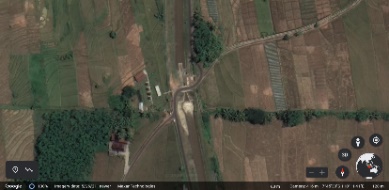 | 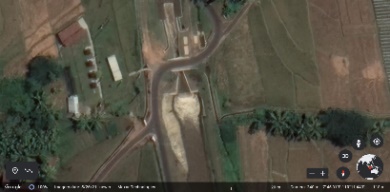 | 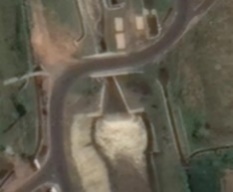 |
Mezo Spatial UAV Phantom 4-DJI | 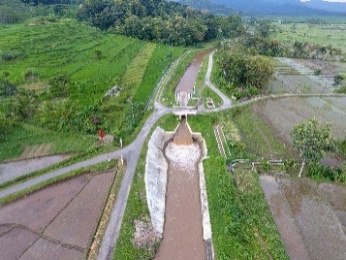 | 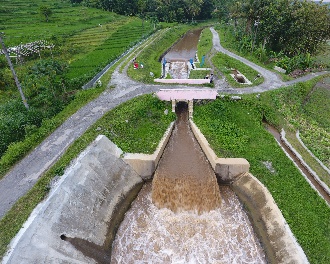 | 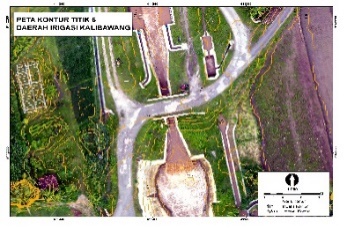 | |
Micro Spatial TS Topcon-DS | The results of this stage are detailed contours with contour intervals of 0.1–0.5 m . Contour image data is used for detailed design planning and determination of design analysis with precision measurements | |||
Based on the results of roof area identification using GE and UAV, the potential area of Off-grid Roof Top PLTS with generated power (P) for 53 houses was obtained as follows in Figure 3 and Table 2. Based on the results of roof area identification using GE and UAV, the potential area of Off-grid Roof Top PLTS with P for 53 houses was obtained as follows. In this study, approximately 10% of the available PV capacity is allocated to support micro-enterprise activities, such as ice crystal production. This proportion is determined based on the relatively low power requirement of the equipment (250 W per unit) compared to the total installed capacity, rather than following a fixed standard allocation [12], [13], [14]. Based on the calculation results presented in Table 2, the total energy generated from 53 households is 596.83 kWh. On average, each house contributes approximately 11.20 kWh, with a minimum value of 1.95 kWh. This variation reflects differences in rooftop area among households, which directly influences the solar energy generation potential. By considering only 10% of the rooftop area for PV installation, the approach remains conservative while still demonstrating significant energy potential [14], [15]. Furthermore, with a power requirement of 250 watts per unit, each household is capable of operating multiple small-scale ice crystal machines, with a minimum capacity of up to 5 units per house [16], [17]. These findings highlight that rooftop-based solar energy can be effectively utilized not only for household electricity needs but also to support micro-enterprise activities, thereby improving local economic resilience.
No. | A (m2) | Radiasi (4.8 kWh/m2) | Koefisien (15%) | A1 (10% × A) | P (kWh/day) | No. | A (m2) | Radiasi (4.8 kWh/m2) | Koefisien (15%) | A1 (10% × A) | P (kWh/day) |
|---|---|---|---|---|---|---|---|---|---|---|---|
1 | 27.12 | 4.8 | 0.15 | 2.7 | 1.95 | 28 | 197.62 | 4.8 | 0.15 | 19.8 | 14.23 |
2 | 243.49 | 4.8 | 0.15 | 24.3 | 17.53 | 29 | 98.21 | 4.8 | 0.15 | 9.8 | 7.07 |
3 | 273.14 | 4.8 | 0.15 | 27.3 | 19.67 | 30 | 139.91 | 4.8 | 0.15 | 14.0 | 10.07 |
4 | 284.61 | 4.8 | 0.15 | 28.5 | 20.49 | 31 | 151.56 | 4.8 | 0.15 | 15.2 | 10.91 |
5 | 112.68 | 4.8 | 0.15 | 11.3 | 8.11 | 32 | 147.55 | 4.8 | 0.15 | 14.8 | 10.62 |
6 | 36.77 | 4.8 | 0.15 | 3.7 | 2.65 | 33 | 188.31 | 4.8 | 0.15 | 18.8 | 13.56 |
7 | 159.26 | 4.8 | 0.15 | 15.9 | 11.47 | 34 | 152.64 | 4.8 | 0.15 | 15.3 | 10.99 |
8 | 195.77 | 4.8 | 0.15 | 19.6 | 14.10 | 35 | 277.47 | 4.8 | 0.15 | 27.7 | 19.98 |
9 | 144.68 | 4.8 | 0.15 | 14.5 | 10.42 | 36 | 186.78 | 4.8 | 0.15 | 18.7 | 13.45 |
10 | 104.27 | 4.8 | 0.15 | 10.4 | 7.51 | 37 | 163.87 | 4.8 | 0.15 | 16.4 | 11.80 |
11 | 94.55 | 4.8 | 0.15 | 9.5 | 6.81 | 38 | 197.17 | 4.8 | 0.15 | 19.7 | 14.20 |
12 | 71.8 | 4.8 | 0.15 | 7.2 | 5.17 | 39 | 188.63 | 4.8 | 0.15 | 18.9 | 13.58 |
13 | 350.82 | 4.8 | 0.15 | 35.1 | 25.26 | 40 | 168.66 | 4.8 | 0.15 | 16.9 | 12.14 |
14 | 217.99 | 4.8 | 0.15 | 21.8 | 15.70 | 41 | 51.49 | 4.8 | 0.15 | 5.1 | 3.71 |
15 | 181.1 | 4.8 | 0.15 | 18.1 | 13.04 | 42 | 146.45 | 4.8 | 0.15 | 14.6 | 10.54 |
16 | 149.43 | 4.8 | 0.15 | 14.9 | 10.76 | 43 | 175.74 | 4.8 | 0.15 | 17.6 | 12.65 |
17 | 345.33 | 4.8 | 0.15 | 34.5 | 24.86 | 44 | 226.8 | 4.8 | 0.15 | 22.7 | 16.33 |
18 | 232.06 | 4.8 | 0.15 | 23.2 | 16.71 | 45 | 355.61 | 4.8 | 0.15 | 35.6 | 25.60 |
19 | 237.87 | 4.8 | 0.15 | 23.8 | 17.13 | 46 | 252.99 | 4.8 | 0.15 | 25.3 | 18.22 |
20 | 89.55 | 4.8 | 0.15 | 9.0 | 6.45 | 47 | 118.68 | 4.8 | 0.15 | 11.9 | 8.54 |
21 | 87.98 | 4.8 | 0.15 | 8.8 | 6.33 | 48 | 138.92 | 4.8 | 0.15 | 13.9 | 10.00 |
22 | 45.84 | 4.8 | 0.15 | 4.6 | 3.30 | 49 | 44.8 | 4.8 | 0.15 | 4.5 | 3.23 |
23 | 39.31 | 4.8 | 0.15 | 3.9 | 2.83 | 50 | 56.68 | 4.8 | 0.15 | 5.7 | 4.08 |
24 | 90.47 | 4.8 | 0.15 | 9.0 | 6.51 | 51 | 131.58 | 4.8 | 0.15 | 13.2 | 9.47 |
25 | 72.3 | 4.8 | 0.15 | 7.2 | 5.21 | 52 | 106.14 | 4.8 | 0.15 | 10.6 | 7.64 |
26 | 93.46 | 4.8 | 0.15 | 9.3 | 6.73 | 53 | 26 | 4.8 | 0.15 | 2.6 | 1.87 |
27 | 217.33 | 4.8 | 0.15 | 21.7 | 15.65 | – | – | – | – | – | – |
Average P (kWh) | 11.20 kWh | ||||||||||
Minimum | 1.95 kWh | ||||||||||
Power consumption (1 unit of crystal ice machine) | 250 watt | ||||||||||
Currently, micro-hydropower electricity is utilized free of charge by the community group (KMTI Kedungrong Community) to meet household electricity needs. The remaining distributed energy is used for ice crystal production, as shown in Figure 4. However, due to limited residual power and the use of small-capacity refrigerators and household freezers, production is limited to approximately 20 kg of ice crystals per day. With a market price of IDR 10,000 per 5 kg, the daily income is only around IDR 40,000. Therefore, the use of dedicated ice crystal machines can increase production capacity up to 200 kg/day. Considering that the power generated by micro-hydropower remains limited, an additional energy source, namely PV systems, is required. This integration not only increases household energy capacity but also supports the development of micro-enterprises in ice crystal production.
4. Conclusion
Sustainable development can be balanced by fulfilling social, economic, and environmental elements. The role of new, renewable energy as environmentally friendly energy can improve social welfare through economic growth and micro-enterprises. This study found a combined potential of pico-hydro, micro-hydro, and solar panels for use in producing crystal ice on a household and community scale. In general, micro-hydropower can be applied in other regions with open irrigation systems, particularly to support local electricity needs. However, for PV systems, considering the required investment and operational costs, this installation was designed based on the presence of an existing local community and an already operational micro-hydropower system. Therefore, the implementation in other regions should be carefully evaluated, particularly in terms of economic feasibility.
Conceptualization, M.A. and A.M.; methodology, M.A.; software, A.A.; validation, M.A., A.F., and F.Z.; formal analysis, M.A.; investigation, E.H.M.; resources, A.M.; data curation, A.A.; writing—original draft preparation, A.F.; writing—review and editing, E.H.M.; visualization, A.F.; supervision, E.H.M.; project administration, A.M.; funding acquisition, E.H.M. All authors have read and agreed to the published version of the manuscript.
The data used to support the research findings are available from the corresponding author upon request.
The authors declare no conflicts of interest.





 Views: 532
 Crossref: 0